
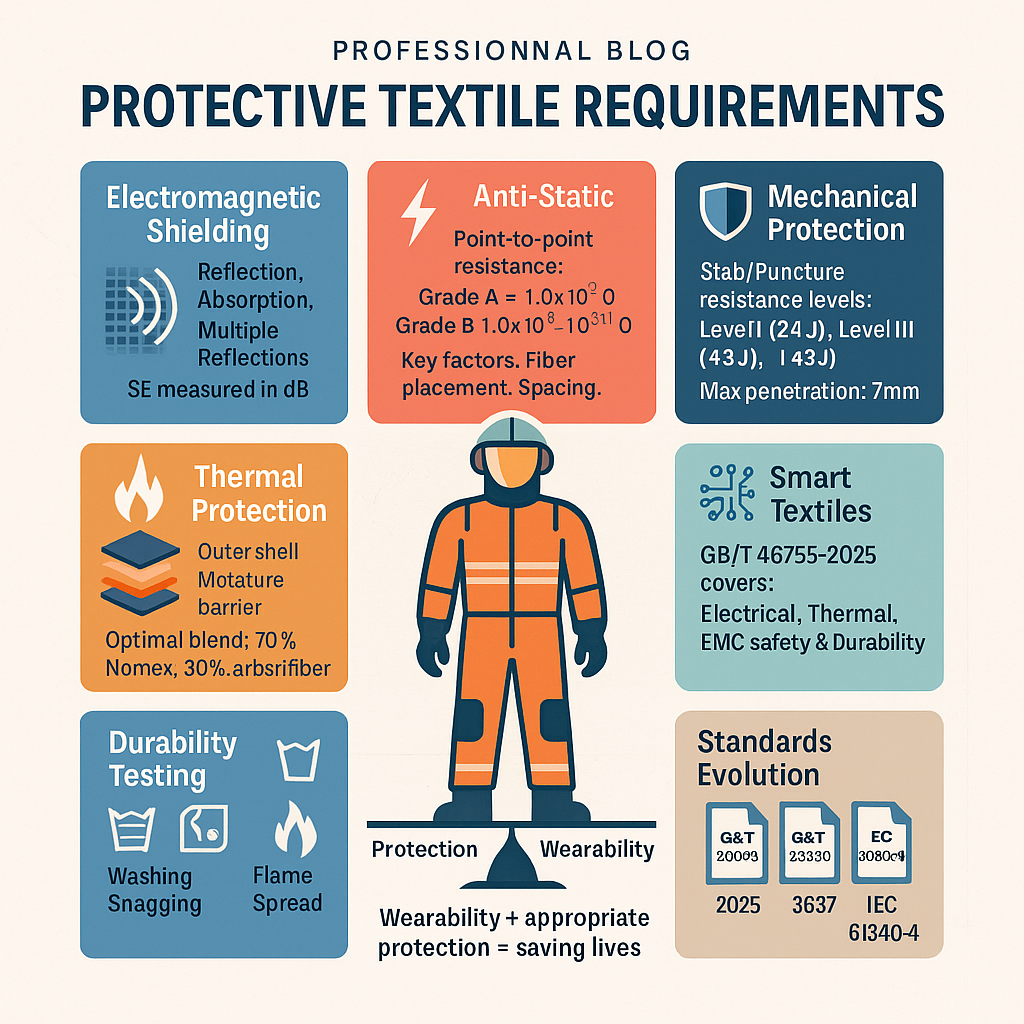
When you see a firefighter running into a burning building or a police officer wearing body armor, you’re looking at some of the most rigorously tested materials in the world. These fabrics don’t just need to look good—they need to perform under extreme conditions, sometimes literally a matter of life and death.
But what exactly makes a protective textile “good enough”? Let’s explore the key performance requirements that these specialized materials must meet.
The Balancing Act: Protection vs. Wearability
Every protective textile faces a fundamental trade-off: the better it protects, the harder it often is to wear comfortably. A solid steel plate would stop almost anything, but you couldn’t move in it. The challenge for textile engineers is finding the sweet spot where protection meets practicality.
The U.S. National Institute of Justice captured this perfectly in their stab standard philosophy: “Wearability + appropriate protection = saving lives” . It’s not just about stopping the threat—it’s about creating gear that people will actually wear and can move in.
Electromagnetic Shielding: Blocking Invisible Threats
Electromagnetic radiation—from cell phones, microwaves, radar, and power lines—is everywhere. While not as immediately dangerous as a bullet, long-term exposure concerns have driven development of shielding fabrics.
How It Works
When electromagnetic waves hit a shielding fabric, three things happen :
- Reflection – Waves bounce off the fabric surface
- Absorption – The material soaks up wave energy
- Multiple reflections – Waves bounce around inside the fabric, losing energy each time
The shielding effectiveness (SE) is measured in decibels (dB). The higher the number, the better the protection. For comparison:
| Protection Level | Shielding Effectiveness | Percentage Blocked |
|---|---|---|
| C (Basic) | 10 dB | 90% |
| B (Intermediate) | 30 dB | 99.9% |
| A (Highest) | 50 dB | 99.999% |
How It’s Made
Manufacturers use several approaches to create shielding fabrics :
- Conductive fiber blending – Mixing metal fibers (stainless steel, silver, copper) with regular fibers during spinning
- Surface modification – Coating or plating existing fabrics with conductive metals
- Filled composites – Embedding conductive particles directly into fibers during extrusion
The key factor? Conductivity. Lower electrical resistance means better shielding. For conductive fiber blends, the placement, spacing, and distribution of conductive fibers all affect performance .
Anti-Static Requirements: Preventing the Spark
In environments with flammable gases, dust, or sensitive electronics, static electricity isn’t just annoying—it’s dangerous. A single spark can ignite an explosion or destroy delicate components.
Testing Anti-Static Performance
China’s GB 12014 standard classifies anti-static clothing into two grades based on point-to-point resistance :
| Grade | Resistance Range | Application |
|---|---|---|
| A | 10⁵–10⁷ Ω | High-risk environments |
| B | 10⁷–10¹¹ Ω | Standard protection |
A 2025 study in the Wool Textile Journal analyzed what makes anti-static fabrics work better . The researchers found that:
- Conductive fiber placement significantly affects performance—how fibers are inserted matters
- Conductive fiber spacing has a strong linear correlation with effectiveness
- Distribution method—whether fibers are evenly spread or concentrated—is the most important factor
The standard test method for measuring garment electrical resistance has been updated in 2026 under IEC 61340-4-9, providing new guidelines for evaluating conductive clothing systems .
Mechanical Protection: Stab and Puncture Resistance
For body armor, the numbers get very specific. How much force can a fabric absorb before it fails?
Energy Levels
The NIJ standard (and corresponding Chinese standards) define protection levels by impact energy :
| Protection Level | Energy Level 1 | Energy Level 2 |
|---|---|---|
| Level 1 | 24 ± 0.5 J | 36 ± 0.6 J |
| Level 2 | 33 ± 0.6 J | 50 ± 0.7 J |
| Level 3 | 43 ± 0.6 J | 65 ± 0.8 J |
The critical number is penetration depth. Across all levels, the maximum allowed puncture depth is 7mm—enough to protect vital organs based on ultrasound measurements of human chest anatomy .
New Testing Standards
A major update came in 2025 with the release of GB/T 20654-2025, which replaces the older 2006 standards. This new standard, effective November 2026, combines two previous test methods into one comprehensive approach for measuring puncture resistance and dynamic tearing . It’s adapted from ISO standards, aligning Chinese requirements with international practices.
Thermal Protection: Keeping Heat Out
Firefighter gear faces perhaps the most extreme conditions. Temperatures can reach hundreds of degrees in seconds. The protective system typically uses three layers :
- Outer shell – Flame-resistant, often aramid fibers
- Moisture barrier – Waterproof but breathable
- Thermal liner – Insulates against heat
Optimizing the Blend
A 2025 study in Results in Engineering tested different fiber blends and weave structures for firefighter fabrics . The winning combination? 70% Nomex with 30% carbon fiber in a Matt weave structure. What made it best? The researchers found that fiber blend proportion contributed about 54% to overall performance, while fabric structure contributed about 25%.
Hydrogel Innovation
Perhaps the most exciting recent development is hydrogel-infused textiles. A comprehensive review published in Polymers in early 2026 examined how hydrogels—three-dimensional polymer networks that hold large amounts of water—could transform firefighter gear .
Here’s how they work: hydrogels absorb water and hold it. When exposed to heat, the water evaporates, pulling heat away from the body. This provides active cooling exactly when it’s needed most. The review notes that hydrogels can be engineered to release water at specific temperatures, creating “smart” fabrics that respond to conditions.
Even better, hydrogels can be functionalized with:
- Silver nanoparticles – Antimicrobial protection against burns and cuts
- Phosphorus compounds – Enhanced flame resistance through char formation
- Temperature-responsive polymers – Release water precisely when it gets hot
New Test Methods for Thermal Protection
A new standard, GB/T 38302-2025, was published in 2025 for measuring thermal protection in flame environments. It covers the “instrumented manikin” test method, where a clothed manikin covered with sensors is exposed to simulated flash fire conditions to measure heat transfer to the body . This method, effective January 2027, gives a realistic picture of how complete garment systems perform.
Smart Textile Requirements: The New Frontier
As textiles get smarter—with heating elements, sensors, and electronics built in—new safety requirements emerge.
The new GB/T 46755-2025 standard for smart textile products, published in 2025, addresses exactly this . It covers:
- Electrical safety – Preventing shocks and short circuits
- Thermal safety – Avoiding burns from heated elements
- Electromagnetic compatibility – Not interfering with other devices
- Durability – Withstanding washing and flexing
The standard applies to heated clothing, monitoring garments, light-emitting textiles, and interactive wearables. It’s designed to ensure that adding electronics doesn’t compromise safety.
Durability Testing: Will It Last?
Protective gear isn’t a one-time use item (usually). It needs to survive repeated wear, washing, and flexing.
New testing methods are coming online:
- Snagging resistance – ASTM D3939/D3939M-26 was updated in January 2026 to standardize how fabrics are tested for pulling and catching
- Flame spread – FZ/T 60056-2025 establishes new methods for measuring how flames travel across protective fabrics
- Liquid repellency – New calibration standards for test equipment ensure consistent results
Putting It All Together
A single protective garment might need to meet requirements from multiple standards simultaneously. A firefighter’s coat must be:
- Flame resistant (thermal protection)
- Waterproof (moisture barrier)
- Breathable (comfort)
- Durable (abrasion resistance)
- Possibly anti-static (depending on environment)
Each requirement adds complexity. The best protective textiles aren’t the ones that maximize any single property—they’re the ones that balance all requirements into a garment that works in the real world.
The Bottom Line
Protective textile standards continue to evolve. New materials like hydrogels promise active cooling. New test methods like the instrumented manikin give better data on real-world performance. New standards for smart textiles ensure that adding electronics doesn’t compromise safety.
What remains constant is the fundamental balance: protection that works without sacrificing wearability. Because the best protective gear is the gear people actually wear.