
What does spun thread mean in sewing thread applications?
Basic definition
Spun thread is a type of sewing thread made from staple fibers that are twisted together to form a continuous strand. Unlike filament threads, which are made from long, continuous fibers, spun threads are composed of shorter fibers that are spun together. This process gives spun thread its characteristic texture and strength, making it suitable for a variety of sewing applications.
Why it matters in sewing performance
The choice of spun thread can significantly impact the performance of a sewing project. Spun threads tend to have a softer feel and better flexibility compared to their filament counterparts. This softness allows for smoother sewing and reduces the risk of fabric damage during the stitching process. Additionally, spun threads generally have a higher resistance to abrasion, making them ideal for high-wear applications.
Where is spun thread used?
Common sewing thread products or applications
Spun thread is widely used in various sewing applications, including:
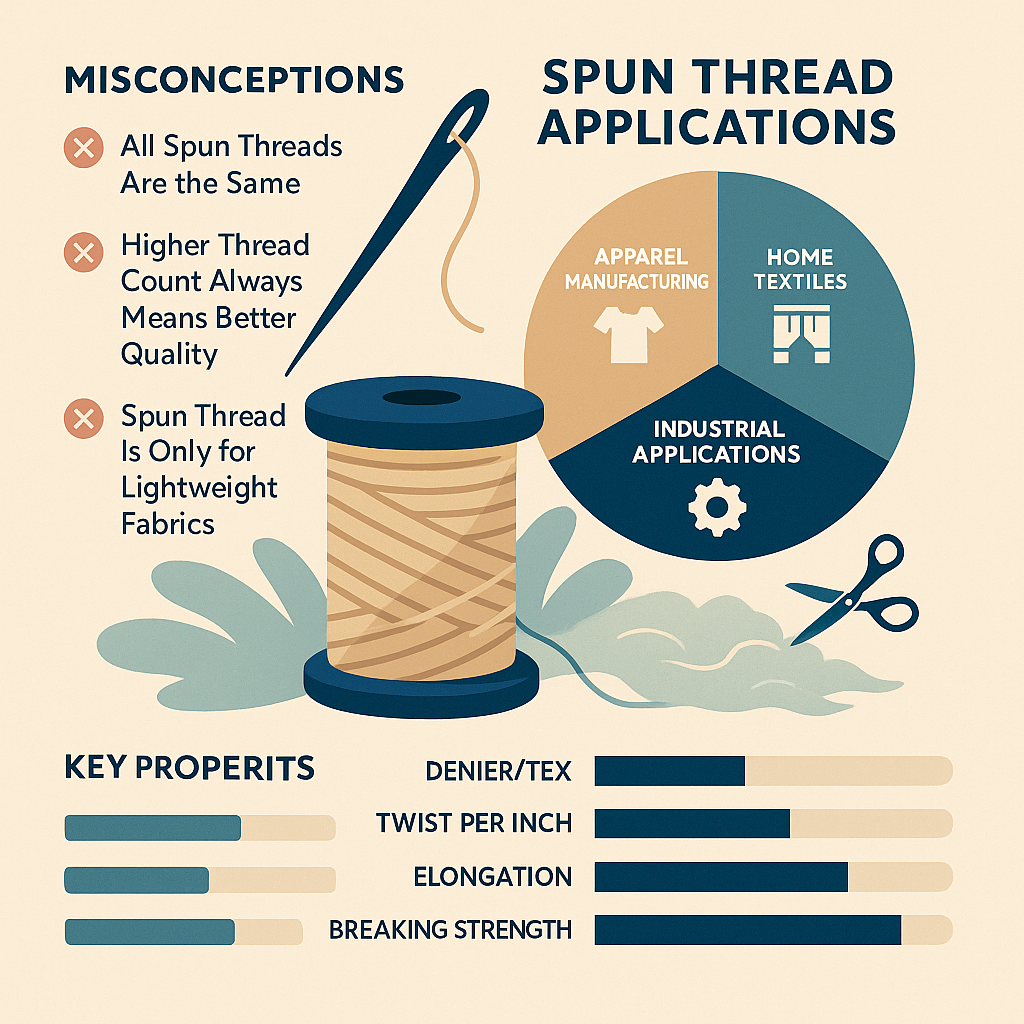
- Apparel manufacturing: Used for stitching garments, spun thread provides the necessary strength and flexibility for seams.
- Home textiles: Ideal for curtains, upholstery, and bedding, spun thread offers durability and a soft finish.
- Industrial applications: Often employed in heavy-duty sewing tasks, such as automotive and furniture manufacturing, due to its strength.
- Crafting: Popular among hobbyists for quilting and other fabric projects, where ease of use is essential.
What buyers usually check
When sourcing spun thread, buyers typically consider several key factors:
- Fiber content: The type of fibers used can affect the thread’s performance and suitability for specific applications.
- Thread count: A higher thread count often indicates a stronger and more durable thread.
- Colorfastness: Important for projects where color retention is critical, especially in apparel.
- Finish: The type of finish applied to the thread can influence its sewing behavior and compatibility with different fabrics.
How to evaluate spun thread
Key points on a specification sheet
When reviewing spun thread specifications, consider the following points:
- Denier or Tex: These measurements indicate the thickness of the thread. A lower number typically means a finer thread, while a higher number indicates a thicker, stronger thread.
- Twist per inch (TPI): This affects the thread’s strength and flexibility. A higher TPI generally results in a stronger thread.
- Elongation: This measures how much the thread can stretch before breaking. Threads with higher elongation can better accommodate fabric movement.
- Breaking strength: A critical factor for assessing the durability of the thread under stress.
Common misunderstandings
There are several misconceptions about spun thread that can lead to poor purchasing decisions:
- All spun threads are the same: In reality, spun threads can vary significantly in terms of fiber content, strength, and application suitability.
- Higher thread count always means better quality: While a higher thread count can indicate strength, it doesn’t always equate to better performance for every application.
- Spun thread is only for lightweight fabrics: Many spun threads are designed for heavy-duty applications and can perform well on a variety of fabric types.
Practical takeaway for sourcing teams
When to ask for samples
Requesting samples is a crucial step in the sourcing process. It allows you to evaluate the thread’s performance in real-world applications. Consider asking for samples when:
- You are unsure about the thread’s compatibility with specific fabrics.
- You want to assess the thread’s sewing behavior, such as tension and stitch formation.
- You are comparing multiple suppliers and need to determine which thread performs best.
When another thread type may fit better
While spun thread is versatile, there are situations where other thread types may be more suitable:
- For high-stress applications: High tenacity polyester filament threads may offer superior strength and durability.
- For specific fabric types: Certain fabrics may require specialized threads, such as bonded nylon for heavy-duty tasks.
- For aesthetic purposes: Specialty threads, such as metallic or decorative threads, may be more appropriate for visible seams.
In conclusion, understanding spun thread is essential for making informed decisions in the sewing industry. By grasping its definition, applications, and evaluation criteria, sourcing teams can better navigate the complexities of thread selection. Whether you are working on apparel, home textiles, or industrial applications, the right spun thread can enhance the quality and performance of your sewing projects.