
Imagine a material lighter than water, stronger than steel, and tough enough to withstand years of sun, salt, and stress without breaking down. That’s not science fiction—it’s ultra-high molecular weight polyethylene, or UHMWPE for short.
You might not recognize the name, but chances are you’ve encountered it. It’s the fiber behind high-performance sailing ropes that don’t rot, fishing lines that can haul in monster catches, and sports equipment that’s both incredibly strong and remarkably light. Let’s explore how this remarkable material is transforming the world of sports and leisure.
What Makes UHMWPE So Special?
To understand why UHMWPE is so popular in sports and leisure, you need to know a few key facts about its properties.
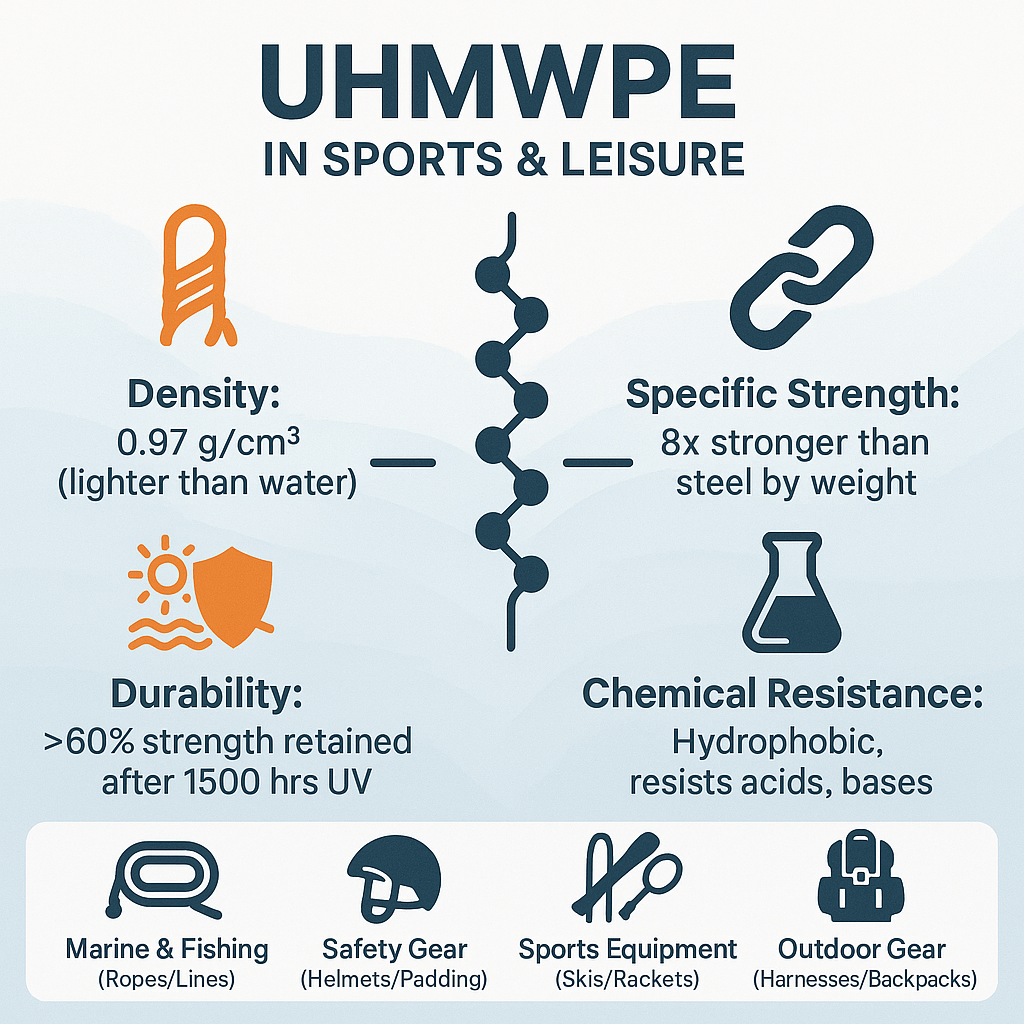
First, it’s incredibly light. With a density of just 0.97 grams per cubic centimeter, it’s lighter than water. That means a rope made from UHMWPE actually floats. Compare that to steel (density 7.8), aluminum (2.7), or even aramid fibers like Kevlar (1.45)—UHMWPE is the lightweight champion among high-performance fibers.
Second, it’s astonishingly strong. Its specific strength—strength relative to weight—is the highest of any commercial fiber. A UHMWPE rope can support the same load as a steel rope weighing eight times as much. In fact, its strength is about 35% higher than aramid and 50% higher than carbon fiber by weight.
Third, it’s tough and durable. Unlike many high-performance fibers that degrade in sunlight or saltwater, UHMWPE shrugs off the elements. After 1,500 hours of exposure to sunlight, it still retains over 60% of its original strength. It resists strong acids, strong bases, and most chemicals. Water doesn’t weaken it. Only a few organic solvents can even make it swell slightly.
| Property | UHMWPE | Steel (for comparison) |
| Density (g/cm³) | 0.97 | 7.8 |
| Floats in water | Yes | No |
| Strength-to-weight ratio | Highest of any fiber | Much lower |
| Sunlight resistance | Excellent | Good (but rusts) |
| Chemical resistance | Excellent | Poor (rusts) |
Ropes and Lines: Where It All Began
UHMWPE’s first major application was in marine ropes and fishing lines—and it’s still one of the most important today.
Marine ropes made from UHMWPE have transformed industries that depend on heavy lifting and mooring. A UHMWPE rope can be up to eight times lighter than a steel rope with the same breaking strength . That matters when you’re handling lines on a ship or securing an offshore oil platform.
The durability is equally impressive. Steel cables rust. Nylon and polyester ropes degrade from sunlight, saltwater, and repeated flexing. UHMWPE ropes resist all of these. They don’t absorb water, so they don’t get heavy when wet. They don’t weaken from UV exposure the way other synthetic ropes do. For supertankers, offshore platforms, and lighthouses, UHMWPE mooring lines last longer and perform better than traditional alternatives .
Fishing lines have also been transformed. UHMWPE fishing line—often sold under brand names like Dyneema® or Spectra®—has become the standard for serious anglers. It’s thinner than monofilament or braided nylon at the same strength, which means you can spool more line onto a reel. It has virtually no stretch, so you feel every nibble and can set the hook instantly. And it’s incredibly abrasion-resistant, which matters when fighting a fish around rocks or coral.
Sailing lines are another major application. Racing yachts need lines that are strong, light, and don’t stretch under load. UHMWPE sheets and halyards meet all these requirements. They’re light enough to handle easily, strong enough to withstand the forces of a stiff breeze, and stable enough to maintain precise sail trim.
Sports Equipment: Lighter, Stronger, Better
Beyond ropes and lines, UHMWPE is finding its way into an expanding range of sports equipment.
Safety gear like helmets and protective padding benefit from UHMWPE’s ability to absorb impact energy. A helmet made with UHMWPE can be thinner and lighter than one made from traditional materials while providing the same level of protection. That’s why you’ll find it in high-end bicycle helmets, ski helmets, and climbing helmets .
Ski and snowboard equipment uses UHMWPE in several ways. The base of a quality ski or snowboard often contains UHMWPE because of its low friction—it glides smoothly over snow and ice. The material also appears in binding components and impact protection.
Racket sports have embraced UHMWPE for its combination of strength and lightness. Badminton and tennis rackets with UHMWPE in their frames or strings can be made lighter without sacrificing stiffness or durability .
Water sports equipment makes perfect use of UHMWPE’s buoyancy and water resistance. Sailboards, surfboards, and kiteboards often incorporate UHMWPE in their construction for added strength without extra weight. The material’s resistance to saltwater and UV means equipment lasts longer, even with heavy use.
Outdoor gear like backpacks, climbing harnesses, and camping equipment use UHMWPE for its strength-to-weight ratio. A climbing sling made from UHMWPE can be thinner and lighter than one made from nylon while holding the same load. That matters when you’re carrying everything on your back.
Why It Works So Well
What makes UHMWPE so effective across such a wide range of applications?
The answer lies in its molecular structure. UHMWPE consists of extremely long polyethylene chains—hence “ultra-high molecular weight.” These long chains are highly oriented, meaning they line up almost perfectly parallel. This alignment gives the fiber its extraordinary strength and stiffness .
The material’s simplicity is also an advantage. Polyethylene is chemically simple and stable. It doesn’t have the complex aromatic rings that give aramid fibers their heat resistance but also make them sensitive to UV and moisture. UHMWPE’s chemical stability means it performs consistently across a wide range of conditions .
And because it’s a polyethylene, it’s naturally hydrophobic—it repels water. This means it doesn’t absorb moisture, doesn’t swell, and doesn’t weaken when wet. For marine and outdoor applications, this is a game-changer.
The Future: What’s Next?
The use of UHMWPE in sports and leisure continues to expand. Manufacturers are finding new ways to incorporate the fiber into consumer products, and advances in production are making it more affordable.
Additive manufacturing (3D printing) using UHMWPE-based materials could open new possibilities for custom sports equipment. Imagine a helmet liner printed to exactly fit your head, or a kayak paddle designed specifically for your stroke .
Recycling and sustainability are becoming more important. As a thermoplastic, UHMWPE can in principle be recycled, and manufacturers are exploring ways to reclaim and reuse the material from end-of-life products. This aligns with the broader push toward sustainability in outdoor recreation .
New composite structures are combining UHMWPE with other materials to achieve property combinations that neither can achieve alone. A composite with UHMWPE for impact resistance and carbon fiber for stiffness could offer the best of both worlds.
A Practical Comparison
| Application | Why UHMWPE is Preferred |
| Marine ropes | Floats, doesn’t absorb water, resists salt and UV |
| Fishing line | Thin, strong, no stretch, abrasion-resistant |
| Sailing lines | Light, strong, low stretch, easy to handle |
| Bicycle helmets | Light, impact-absorbing, thin profile |
| Ski bases | Low friction, durable, glides well |
| Racket sports | Strong, light, stiff |
| Backpacks and climbing gear | High strength-to-weight, durable |
| Water sports equipment | Buoyant, water-resistant, UV-resistant |
The Bottom Line
UHMWPE represents one of the most successful examples of materials science improving everyday experiences. It’s not a fiber you see, but it’s one you can feel—in the fishing line that doesn’t snap, the sailboat line that handles easily, the helmet that protects without weighing you down.
What makes UHMWPE so remarkable is that it delivers extraordinary performance in conditions where other materials fail. It doesn’t weaken in sunlight. It doesn’t absorb water. It doesn’t rot or corrode. It just keeps working, year after year.
Next time you’re on the water with a fishing rod, sailing a boat, or hitting the slopes, take a moment to appreciate the invisible fiber that might be making it all possible. It’s light enough to float, strong enough to haul, and tough enough to last.