
Most people picture protective gear as stiff, clunky stuff—like a metal plate or a vest that makes you walk like a robot. But stab-resistant materials today? Totally different. They’re flexible, they move with you, and they stop a blade without weighing you down.
So how do they pull that off? It comes down to two things: the way the fabric is built, and the finishing tricks that make it actually work.
The Four Main Fabric Structures
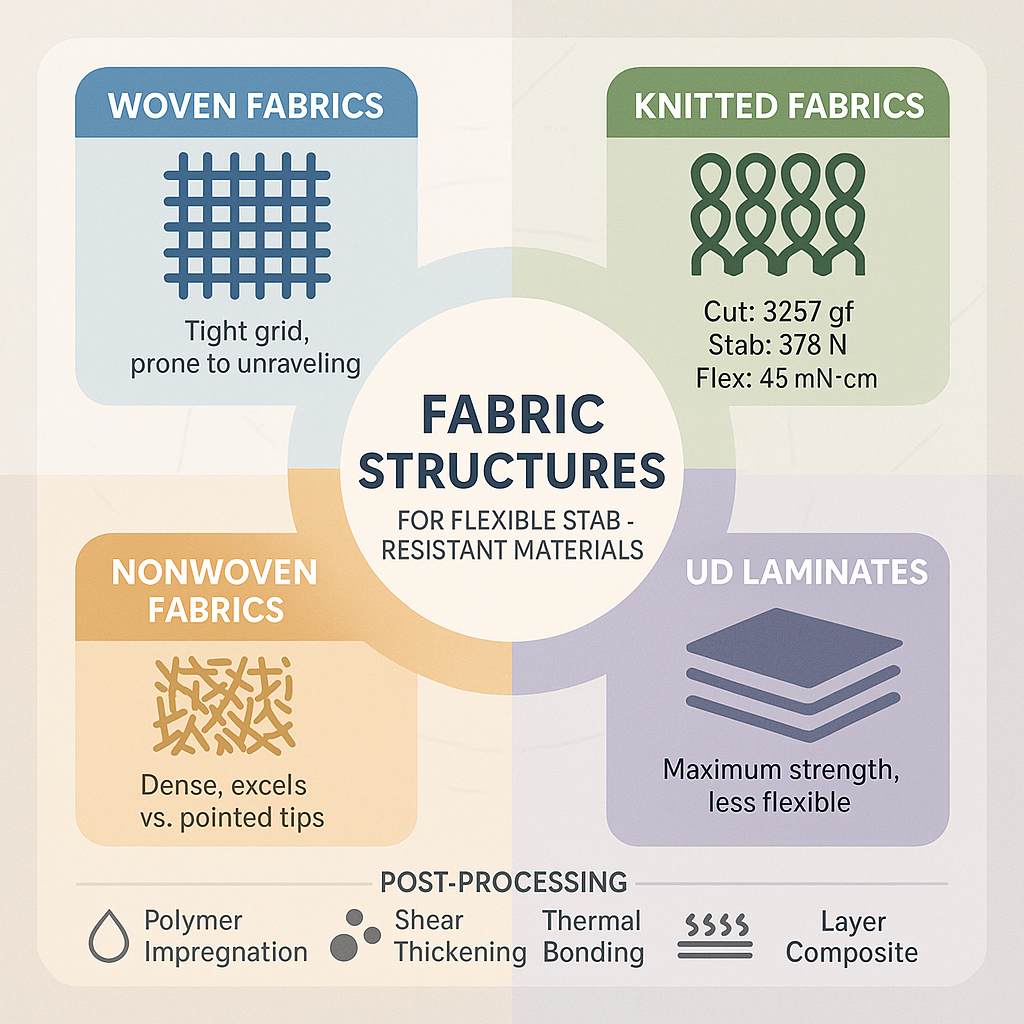
Not all fabrics are created equal when it comes to stopping a blade. The way fibers are arranged—woven, knitted, nonwoven, or laid in parallel—makes a huge difference in how the material responds to a stabbing attack.
Woven Fabrics: The Traditional Workhorse
Woven fabrics are the most common structure used in stab-resistant materials. In a woven fabric, yarns cross over and under each other in a grid pattern—like a basket weave. For protective applications, manufacturers typically use very tight weaves with high yarn density, such as plain weave or three-dimensional woven structures .
The tight structure makes it difficult for a blade to push through. However, there’s a trade-off: once a blade does penetrate and breaks a few yarns, the woven structure can unravel quickly. The interlacing points where yarns cross can allow cracks to spread, and the protective performance can suddenly fail .
Think of it like a tightly woven net. It’s hard to push a knife through, but once you break a few strands, the hole can widen rapidly. That’s why woven fabrics often need additional treatments—like coatings or resin impregnation—to lock the yarns in place and prevent that catastrophic failure .
Knitted Fabrics: Flexibility with a Self-Locking Trick
Knitted fabrics are naturally more flexible and stretchy than woven ones. But historically, that flexibility came at a cost: the loops in knitted structures could open up under a blade, allowing penetration.
Recent innovations have changed that. In 2025, researchers developed a “lock-ring structure” knitted material that uses a clever mechanism . Here’s how it works: when a blade strikes, the knitted loops slide and tighten around the tip, creating a “self-locking” effect. The harder the blade pushes, the tighter the loops grip—wrapping around the knife tip and absorbing impact energy .
This lock-ring structure combines polyamide (PA) with ultra-high molecular weight polyethylene (UHMWPE) to create a braided yarn, which is then knitted into a protective material. After a hot-pressing step, the polyamide portions melt and bond the loops together, creating rigid protective modules within the flexible structure.
The results are impressive :
- Cut resistance: 3257 grams-force (excellent)
- Stab resistance: 378 Newtons
- Flexibility: 45 mN·cm (very soft and pliable)
- Low-speed impact protection: 16 Joules
The material also demonstrated a 114.6% improvement in stab resistance when a double-locking structure was used. This design creates a synergistic effect: the loops interlock and bond together, forming a multi-layer defense that rapidly absorbs and disperses impact energy.
Imagine a mesh of small, interlocking rings that stiffen instantly when struck. That’s the lock-ring concept in action—and it’s a major step forward for knitted protective materials .
Nonwoven Fabrics: Dense and Puncture-Resistant
Nonwoven fabrics are made by bonding fibers together without weaving or knitting. The fibers are randomly oriented, creating a dense, homogeneous structure that has no weak points—no gaps for a blade to slip through .
Research has shown that nonwoven structures are particularly effective against sharp, pointed objects like ice picks. A study found that nonwovens stop penetration in two ways :
- Deformation – The material stretches and deforms around the tip, absorbing energy
- Fiber fracture – The fibers break, but only after absorbing significant energy
The density of the nonwoven matters enormously. Researchers tested nonwovens with densities ranging from about 0.14 g/cm³ to 0.46 g/cm³ and found that both stab resistance and stiffness increase with density .
But here’s the clever part: by using a monolayer hot-press method (pressing each layer individually rather than stacking them), manufacturers can achieve high stab resistance while maintaining much better flexibility. The flexural rigidity—how stiff the material feels—stays low even at high densities .
Nonwovens do have limitations, though. While they excel against pointed objects like ice picks, they can be less effective against slashing attacks because the randomly oriented fibers can be pulled apart by a slicing motion .
Unidirectional (UD) Laminates: The Specialized Solution
Unidirectional laminates—often called “unwoven” or “UD” materials—are made by laying parallel fibers in one direction, bonding them with resin, then stacking layers at 90-degree angles and bonding again. The result is a material where every fiber lies perfectly straight with no crimp or bending .
This structure preserves nearly all of the fiber’s inherent strength, making UD materials exceptionally strong. However, there’s a trade-off: UD materials are much stiffer than woven or knitted fabrics. Testing has shown that while UD laminates offer excellent protection with minimal thickness, they lack the flexibility needed for comfortable wearable gear .
That’s why UD materials are typically used in hard armor plates or as the core layer in multi-layer systems, rather than in flexible protective clothing on their own .
How Different Structures Compare
| Structure | Flexibility | Stab Resistance | Cut Resistance | Best For |
|---|---|---|---|---|
| Woven | Moderate | Good | Moderate | General protection with post-processing |
| Knitted (lock-ring) | Excellent | Very high | Very high | Flexible, comfortable wear |
| Nonwoven | Moderate to low | Very high (against points) | Moderate | Pointed weapon protection |
| UD Laminate | Low | Very high | Very high | Hard armor, core layers |
Post-Processing: Making Good Fabrics Great
Raw fabrics rarely provide sufficient stab protection on their own. They need additional processing—what the industry calls “post-processing”—to reach their full protective potential .
Polymer Impregnation and Coating
One of the most common methods is impregnating the fabric with polymers—thermoplastic resins, polyurethane, or other adhesives. The resin fills the gaps between fibers and locks them in place, making it much harder for a blade to push fibers apart .
Different polymers serve different purposes:
- Polyurethane creates flexible, durable bonds
- Surlyn ionomer (a specialized plastic) forms tough, self-healing films
- Water-based adhesives are gaining popularity for being environmentally friendly while still effective
When the resin cures, it forms a film that not only stiffens the structure but also prevents crack propagation if the fabric is penetrated. Some coatings even use hard particles—like metal or ceramic nanoparticles—to create a “hard shell” surface that further resists cutting .
Shear Thickening Fluid (STF) Treatment
Shear thickening fluids are a fascinating recent development. These fluids are liquid under normal conditions but instantly become rigid when struck with force. The effect is similar to cornstarch mixed with water—it flows like a liquid when stirred slowly, but turns solid when punched .
Recent research has advanced this technology significantly. In 2026, scientists developed STF treatments with multi-walled carbon nanotubes (MCNT) that not only improve impact resistance but also provide sensing capabilities . The material can detect impact energy—with sensitivity exceeding 9.12 J⁻¹—making it “smart” armor that can report when it’s been struck.
When STF is impregnated into aramid or UHMWPE fabrics, it dramatically improves stab resistance while maintaining flexibility. The fluid hardens at the exact point of impact, creating a temporary solid shield that stops the blade .
The mechanism is elegant: under low stress, the fluid flows easily, allowing the fabric to remain soft and flexible. Under high stress—like a knife thrust—the nanoparticles in the fluid jam together, creating a solid barrier. Once the stress is removed, the fluid returns to its liquid state, and the fabric regains its flexibility .
Thermal Bonding and Hot Pressing
Heat can be used to activate and cure polymers within the fabric. In the lock-ring knitted material discussed earlier, hot-pressing causes the polyamide components to melt and bond the loops together, creating rigid modules within the flexible structure .
This thermal bonding step is critical for achieving the right balance of protection and flexibility. The temperature, pressure, and duration must be carefully controlled—too little and the bonds won’t form properly, too much and the fabric becomes stiff and brittle .
Layer Composite (Multi-Structure Hybrids)
No single structure does everything perfectly. That’s why manufacturers often combine different fabric structures to create hybrid materials .
A common approach pairs a tightly woven outer layer to stop slashing attacks with a nonwoven inner layer to catch pointed objects. Another approach stacks several layers of resin-impregnated woven fabric, each layer offset slightly from the previous, to create a material that’s both flexible and highly resistant to penetration .
Recent patents describe three-layer systems designed specifically for police and security applications: an outer layer with specific adhesive formulations, a middle protective layer, and a buffer layer that improves comfort while maintaining protection .
What’s Next?
The field of flexible stab-resistant materials is evolving rapidly. Here are some trends to watch:
- Smart sensing – Materials that detect and report impacts, making protective gear “active” rather than passive
- Sustainable processing – Water-based adhesives and recyclable materials are becoming more common
- Multi-threat materials – Combining stab, ballistic, and cut protection in a single, flexible system
- Bio-inspired structures – Designs inspired by fish scales and snake skin that combine flexibility with hardness
The Bottom Line
Flexible stab-resistant materials have come a long way from heavy, stiff vests. Today’s protective gear combines clever fabric structures—woven, knitted with lock-rings, nonwoven, or unidirectional laminates—with advanced post-processing techniques like polymer impregnation and shear thickening fluid treatment.
Each structure has its strengths: woven fabrics are strong and proven, lock-ring knits offer unprecedented flexibility, nonwovens excel against pointed weapons, and UD laminates provide maximum strength. Each processing technique adds another layer of protection, from resin bonding to heat-activated stiffening.
The goal isn’t just to stop the blade—it’s to let the wearer move, work, and respond effectively while staying safe. That balance between protection and wearability is what makes modern flexible stab-resistant materials so remarkable.