
Protective textiles have come a long way from the heavy, rigid armor of the past. Today’s materials are lighter, smarter, and more comfortable—designed for people who need to move freely while staying protected. Let’s take a look at some of the most interesting developments happening around the world right now.
Materials That Learn from Nature
Sometimes the best ideas come from looking at how nature solves problems. Researchers have been studying fish scales—yes, fish scales—to design better protective materials .
Here’s the clever part: fish scales have a hard, ridged outer layer for stiffness and a soft, flexible inner layer made of collagen fibers. This combination lets fish stay agile while resisting bites from predators. Scientists created a multi-layer structure that mimics this design, using aramid fiber composites for the flexible base and adding surface ridges for extra stiffness .
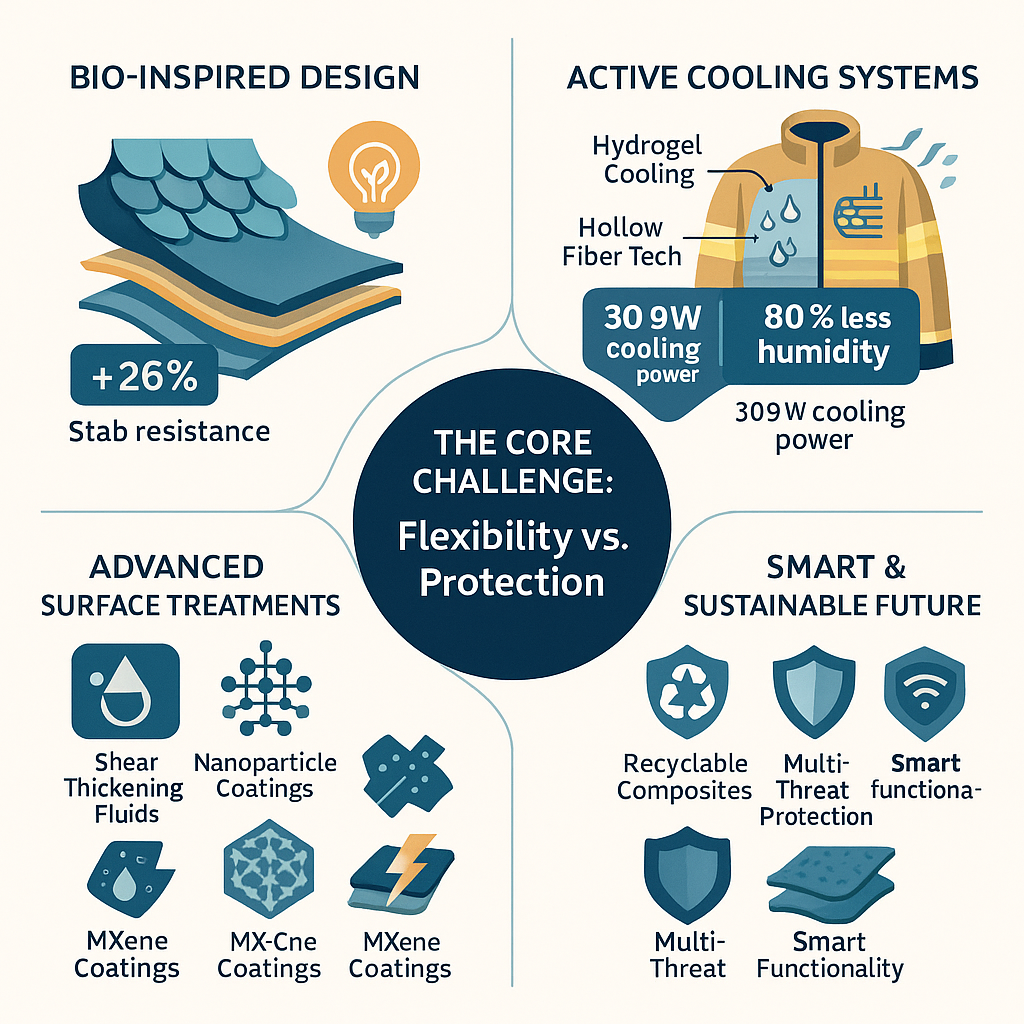
What did they find? The ridged surface is about 200% to 275% softer than a flat structure—meaning it bends easily—while still providing excellent protection. When they added a mineralized inner layer, stab resistance increased by another 26% . This approach shows real promise for making protective gear that’s both flexible and effective.
Smarter Fabrics for Firefighters
Firefighter gear has traditionally relied on aramid fibers like Nomex and Kevlar for thermal protection. But there’s a well-known problem: these materials keep heat in as well as out. Firefighters can suffer from heat stress even when the flames aren’t touching them .
New research is exploring hydrogels—three-dimensional polymer networks that can hold large amounts of water—as a solution . When integrated into textile layers, hydrogels provide a cooling effect as water evaporates from the gel structure. The cooling efficiency depends on water content, temperature, and humidity, but the basic mechanism is simple: turning liquid water into vapor absorbs heat, keeping the wearer cooler .
What makes this exciting is the ability to fine-tune hydrogels for specific needs:
- Smart hydrogels respond to temperature changes, releasing more water precisely when it gets hot
- Antimicrobial versions incorporate silver nanoparticles to help prevent infections
- Flame-retardant formulations use phosphorus compounds to enhance fire resistance
Another promising approach involves liquid-cooled garments using hollow fiber membrane technology . These systems circulate chilled liquid through tiny tubes embedded in the fabric, actively removing heat from the body. A recent study showed this technology achieves 30.9 watts of cooling power—about 22% more than traditional liquid-cooled garments—while also reducing humidity inside the garment by nearly 80% . For firefighters working in extreme conditions, this combination of cooling and dehumidification could make a real difference.
How Do We Know It Works?
New protective materials need rigorous testing. The latest international standards reflect this need.
A new ISO standard for heat and flame protective clothing was published in 2025, establishing methods for testing complete garments using instrumented manikins . These manikins are covered with heat sensors—up to 120 of them in some systems—and exposed to controlled flames while sensors continuously measure heat transfer . The results help manufacturers understand exactly how their garments perform under real-world conditions.
The NFPA 1970 standard was also updated in 2025, consolidating several older standards into one comprehensive document . New requirements include:
- Updated end-of-service time indicators for breathing apparatus
- Removable soft goods for easier cleaning
- Bluetooth connectivity indicators to confirm radio communication
These updates reflect a growing emphasis on usability and maintenance, not just raw protection numbers.
Surface Treatments That Change the Game
Here’s a trend worth watching: instead of creating entirely new fibers, researchers are finding ways to modify the surfaces of existing high-performance textiles to give them new capabilities.
Shear thickening fluids are a good example . These are liquids that behave normally under gentle handling but turn rigid when hit hard. When impregnated into Kevlar or UHMWPE fabrics, they dramatically improve stab and puncture resistance without adding significant weight or stiffness .
Other surface treatments include:
- Nanoparticle coatings that increase friction between yarns, making it harder for blades to push fibers aside
- Sol-gel ceramic networks that harden the fabric surface while maintaining breathability
- Plasma-enhanced deposition that creates durable, abrasion-resistant coatings
- MXene-based coatings that combine mechanical reinforcement with electrical conductivity for smart functionality
The beauty of these approaches is that they work with existing manufacturing infrastructure. You don’t need to reinvent the fiber—you just need to treat its surface.
Cooling After Exposure
What happens after firefighters leave the heat? A 2025 study examined four different cooling methods for firefighters after heat exposure :
| Cooling Method | How It Works | Effectiveness |
| Natural cooling | Rest without removing gear | Baseline |
| Stripping cooling | Removing protective clothing | Best performer—no skin burns observed |
| Fan cooling | Forced air circulation | Extended time to burns by 3-11% |
| Water spray cooling | Mist or spray application | Least effective; longer spray times actually reduced protection |
The study found that simply removing gear when safe to do so was the most effective cooling strategy . This may seem obvious, but it highlights an important point: sometimes the simplest solutions work best, and design should enable quick doffing when conditions permit.
The Bigger Picture: Flexibility vs. Protection
If you look across all these developments, a common theme emerges: the challenge of balancing protection with flexibility.
Traditional approaches often solved this by adding more layers or using heavier materials. Newer approaches are more sophisticated:
- Bio-inspired structures that combine stiff and flexible zones in one material
- Smart materials that change properties under impact
- Surface treatments that enhance performance without adding bulk
- Active cooling systems that manage heat rather than just blocking it
The goal isn’t just higher protection numbers—it’s wearable protection that people can actually wear comfortably for extended periods.
Where Things Are Headed
What’s next? Several trends worth watching:
Recyclable composites are gaining attention. Researchers are developing polyurethane-based materials that maintain high puncture resistance while being recyclable at end of life . Dynamic covalent bonds allow these materials to be reprocessed rather than discarded.
Multi-threat protection is another frontier. Instead of separate solutions for bullets, knives, and blunt impacts, researchers are working on materials that handle all three . This requires carefully engineering both the fibers and the interfaces between them.
Smart functionality is moving from research labs into products. The ability to monitor temperature, detect breaches, or even communicate status is becoming part of protective equipment design .
Final Thoughts
Protective textiles have evolved remarkably over the past decade. The materials being developed today—from fish-scale-inspired composites to hydrogel-cooled fabrics—represent a fundamental shift in how we think about protection.
The focus is no longer just on stopping threats. It’s on creating systems that keep people safe while letting them move, work, and breathe comfortably. That balance between protection and wearability may be the most important frontier in protective textiles right now.
References
- Liu, Y., et al. “Bio-inspired design and stab resistance performance of flexible fiber composites.” Composites Part B: Engineering, 2025.
- “A Review of Textile Hydrogel Integration in Firefighting Personal Protective Clothing.” Polymers, 2026.
- Zhou, J., et al. “Performance evaluation of a novel liquid-cooled and dehumidified garment based on hollow fiber membrane.” Applied Thermal Engineering, 2025.
- MSA Safety. “NFPA 1970 2025 Certified: The MSA G1™ SCBA XR Edition.” 2025.
- Standards New Zealand. “AS/NZS ISO 13506.1:2025 Protective clothing against heat and flame.” 2025.
- “Advanced surface functionalization for smart, flexible and multi-threat impact resistance protective textiles and composites.” Defence Technology, 2026.
- Institute for Standardization of Bosnia and Herzegovina. “prBAS ISO 11999-3:2026 PPE for firefighters.” 2025.
- Fire Apparatus Magazine. “MSA Safety’s Breathing Apparatus Compliant with NFPA.” 2025.